“Excellent book. I really like this book and the suggestions it gives in helping you to change your mindset. I suffer from severe anxiety and reading this has given me a few different ideas and techniques in helping me to identify my obstacles, take better control of my thoughts, and be successful in taking back control over my life. I think the workbook portion is a huge bonus too because it truly helped me in identifying issues that were contributing factors that I hadn't even considered before.”
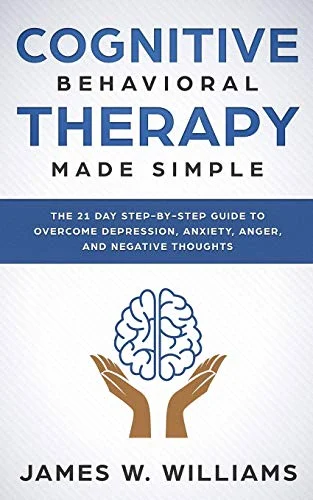
— Book by James W. Williams
Cognitive Behavioral Therapy: Made Simple - The 21 Day Step by Step Guide to Overcoming Depression, Anxiety, Anger, and Negative Thoughts (Practical Emotional Intelligence)
Cognitive Behavioral Therapy: Made Simple - The 21 Day Step by Step Guide to Overcoming Depression, Anxiety, Anger, and Negative Thoughts (Practical Emotional Intelligence)
Prices as of May 8, 2026 · subject to change on retailer.
The thought arrives before you do. By the time you notice it, it has already changed how the room looks.
WHAT CBT ACTUALLY DOES
Cognitive behavioral therapy isn't positive thinking. It isn't "replace bad thoughts with good ones." It's a narrower and more useful observation: emotions follow thoughts, thoughts follow learned patterns, and those patterns can be mapped. The book opens by recovering that distinction, because the watered-down version of CBT is exactly what some readers correctly criticize — and the actual version deserves to be told apart from it.
HOW THE 21 DAYS ARE STRUCTURED
WHO IT'S FOR
The reader before — or alongside — therapy who wants the framework laid out simply. Someone who's noticed they keep getting caught in the same kinds of thought loops and is ready for a structured way to interrupt them. The professional preparing to support a partner, a child, or a team member through a hard period and wanting honest vocabulary first.
WHAT IT'S NOT
Not a substitute for therapy when symptoms are severe or persistent. Not a clinical manual — a CBT therapist with twenty years of practice will find this familiar ground (one such reader said exactly that). Honest reviewers flagged earlier editions for editing issues, which have been revised. Read it as a 21-day on-ramp, not as the final word.
You don't change what you feel by demanding to feel different. You change what you think — and what you think, repeated, ends up changing almost everything else.
— James W. Williams
WHAT CBT ACTUALLY DOES
Cognitive behavioral therapy isn't positive thinking. It isn't "replace bad thoughts with good ones." It's a narrower and more useful observation: emotions follow thoughts, thoughts follow learned patterns, and those patterns can be mapped. The book opens by recovering that distinction, because the watered-down version of CBT is exactly what some readers correctly criticize — and the actual version deserves to be told apart from it.
HOW THE 21 DAYS ARE STRUCTURED
- Days 1-7 — naming the distortions. Catastrophizing, all-or-nothing, mind-reading, overgeneralization. The technical names for the cognitive errors that fire a hundred times a day. Naming weakens them.
- Days 8-14 — thought records and restructuring. The actual tool: situation, emotion, automatic thought, evidence for, evidence against, fairer alternative. The technique clinical CBT uses, simplified for daily practice.
- Days 15-21 — the behavioral half. Activation when mood drops. Exposure when anxiety dictates. Small behavioral experiments that test whether the belief actually holds in reality.
- The workbook integration. Reviewers specifically flagged the journaling space and end-of-chapter exercises as the highest-leverage part — the difference between reading about CBT and practicing it. Skip those and the book delivers half its value.
- The CBT/EI/Stoicism overlap. A useful thread the book pulls: cognitive restructuring, emotional intelligence, and Stoic dichotomy-of-control are the same insight from three angles. Recognizing the overlap makes any one of them easier to install.
WHO IT'S FOR
The reader before — or alongside — therapy who wants the framework laid out simply. Someone who's noticed they keep getting caught in the same kinds of thought loops and is ready for a structured way to interrupt them. The professional preparing to support a partner, a child, or a team member through a hard period and wanting honest vocabulary first.
WHAT IT'S NOT
Not a substitute for therapy when symptoms are severe or persistent. Not a clinical manual — a CBT therapist with twenty years of practice will find this familiar ground (one such reader said exactly that). Honest reviewers flagged earlier editions for editing issues, which have been revised. Read it as a 21-day on-ramp, not as the final word.
You don't change what you feel by demanding to feel different. You change what you think — and what you think, repeated, ends up changing almost everything else.
— James W. Williams
— Readers say
What readers are saying.
“Encouragement for the journey. The book helps establish tools you can use to work through tough emotional struggles. The book helps you to overcome life's difficulties, and to make choices to live life with joy.”
“Simple & Easy Enough To Grasp. What caught me about this book and convinced me to keep going was one simple sentence: "You are not deep in the trenches fighting with guns against an enemy seeking to destroy you as well, but the battles that you fight within can take the same emotional toll on you." This simple sentence helped me to realise the importance and simplicity of getting to know me and how I best can control my emotions. I realised that if I wasn't going to learn how to control my emotions for myself, I needed t...”
“easy to understand. The problem with a lot of medical/psychology/psychiatry books are that they are written in a way that seems to be a hidden language to the lay person. This book is different, the author doesn’t use any fancy words, he uses language that is easy to follow and understand but also engages the reader so that they feel confident in what they are reading. This is a great book and one that I recommend to anyone who wants to understand more about their own issues or wants to help a friend or family m...”
“Follow the process!. I’ve been reading a lot of self-help,self-love along with anxiety and depression this is by far the best and most beneficial one I have come a crossed! I wanted to read days in advanced but going Day by day proved to let me process and fully grasp and understand the material. I could see changes by day 3. So thankful”
“INFORMATIVE.... If you can relate to these scenarios, then you are not alone. Millions of people struggle with life daily and are unable to find healthy coping mechanisms. In here Days Step by Step Guide to Overcoming Depression, Anxiety, Anger and Negative Thoughts provides practical solutions for dealing with your emotions. I'm satisfied with this guidebook. Finally, I want to suggest that for everyone.”
James W. Williams
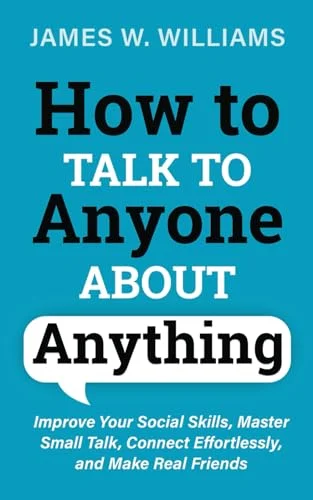
How to Talk to anyone About Anything: Improve Your Social Skills, Master Small Talk, Connect Effortlessly, and Make Real Friends (Communication Skills Training)
How to Talk to anyone About Anything: Improve Your Social Skills, Master Small Talk, Connect Effortlessly, and Make Real
James W. Williams
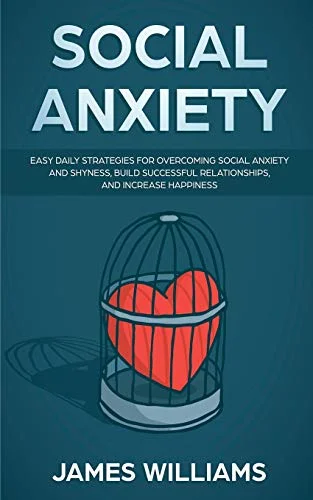
Social Anxiety: Easy Daily Strategies for Overcoming Social Anxiety and Shyness, Build Successful Relationships, and Increase Happiness
Social Anxiety: Easy Daily Strategies for Overcoming Social Anxiety and Shyness, Build Successful Relationships, and Inc

James W. Williams
Dating: Secrets for Introverts - How to Eliminate Dating Fear, Anxiety and Shyness by Instantly Raising Your Charm and Confidence with These Simple Techniques
Dating: Secrets for Introverts - How to Eliminate Dating Fear, Anxiety and Shyness by Instantly Raising Your Charm and C