In a 2026 JAMA Psychiatry trial reported by NYU Langone Health, 54.2% of adults with generalized anxiety disorder responded to Kundalini yoga, which is one reason stress relief yoga deserves a careful, grounded look. For you, that number means yoga may help the body soften its alarm signals, while still not replacing care that may be needed for severe or ongoing anxiety.
Take one slow breath before we go further. Feel the weight of your sitting bones, or the pressure of your feet inside your socks. The question I want to stay with is not whether yoga “works” in some tidy, glossy sense. The more honest question is whether stress relief yoga can meet your actual nervous system on an actual day — the day with the tight jaw, the unread messages, the hip that complains, the mind that keeps circling one sentence someone said at 8:12 a.m.
“You are your biggest critic; we all have a negative inner voice that is always trying to prevent us from living our best lives.”
— Amy White, Relationship Anxiety
My answer is cautious, but hopeful: yoga helps stress most when it begins before the shape of the pose. It begins in pacing, consent, breath, attention, and the decision not to turn practice into another small arena where you fail yourself.
What Are We Asking of Stress Relief Yoga?
Can stress relief yoga give the body a felt experience of safety before the mind has finished explaining why it feels unsafe?
That is the investigation, at least for me. I’m less interested in whether you can fold forward beautifully or hold a long Warrior II with the steadiness of a bronze statue. I care whether your shoulders drop half an inch while the soup warms on the stove. I care whether you notice your breath before you send the sharp reply. Small things. Very small, sometimes.
Stress is not only a thought. Stress is the hand gripping the steering wheel after the danger has passed. Stress is the belly held in all afternoon. Stress is lying down in bed and realizing your tongue is pressed to the roof of your mouth as if it’s bracing for weather.
Yoga can meet stress through the body because stress often lives there first. The National Center for Complementary and Integrative Health notes that yoga may help with stress management, mental health, and sleep, while also reminding readers that yoga should be adapted for safety and individual conditions. I appreciate that plainness. No incense cloud of certainty. No promise that one breathing practice will tidy the whole nervous system by Thursday.
In my own practice, the first sign that yoga is helping is rarely dramatic. I don’t rise from the mat reborn. I notice that I’m not clenching my toes. I notice that I can hear the refrigerator hum. I notice that my breath has stopped arriving like a delivery person pounding on the door.
Stress relief yoga works best when it is treated as a conversation with the body, not a performance for the body. A conversation includes listening. A conversation includes changing the subject when the other person goes quiet. If a pose makes your breath jagged, your body has already spoken.
And yes, I know. Some of us were taught to override that voice.
Many wellness spaces still carry a hidden athleticism, even when the words are soft. “Relax deeper.” “Surrender more.” “Just breathe.” I’ve said versions of these things myself, and I’ve had to unlearn the laziness inside them. A person with pain, trauma, hypertension, fibromyalgia, grief, or plain exhaustion may not need to “go deeper.” A person may need to come out of the pose, place a hand on the wall, and take two ordinary breaths with eyes open.
Stress relief yoga begins when the body is allowed to have an opinion.
Yoga Helps Stress Through Regulation, Not Escape
Yoga seems to reduce stress most reliably when breath, movement, and attention teach the nervous system to shift gears more gently.
A systematic review by Pascoe and Bauer, “A systematic review of randomised control trials on the effects of yoga on stress measures and mood,” is often discussed in relation to yoga’s effects on stress physiology and mood. More recently, a 2026 Frontiers in Public Health article, “Reduce stress and the risk of burnout by using yoga techniques”, points toward the usefulness of yoga-based techniques for stress and burnout contexts. The language is measured, which is how I prefer it. Yoga is not magic. Yoga is practice repeated inside a life that keeps happening.
The mechanism I see most often in real rooms, with real mats and real knees, is not escape. It is regulation. Regulation means the body learns, little by little, that activation can rise and fall without becoming the whole story. The breath quickens in a balancing pose. The foot wobbles. The mind says, “I’m bad at this.” Then the exhale lengthens, the gaze softens, and the body learns that wobbling did not ruin anything.
That lesson travels.
It travels to the email you don’t want to open. It travels to the medical appointment waiting room. It travels to the moment your child calls from the other room in the exact tone that means something sticky has happened. Stress relief yoga is less about becoming calm on command and more about getting familiar with the doorway back toward calm.
The breath is not a remote control
Breath work is sometimes taught as if you can press the right button and make anxiety vanish. I wish the body were that simple. Or — actually, no, I don’t. The body’s complexity is part of its intelligence.
Slow breathing can be deeply settling for many people, especially when the exhale is longer than the inhale. A simple pattern I often use is inhaling for four counts and exhaling for six, with no strain at the top or bottom of the breath. The point is not to perform serenity. The point is to give the nervous system a rhythm it can lean toward.
For some people, breath focus increases distress. This is important. If you’ve ever been told to “just breathe” while your chest tightened more, you are not broken. You may need movement first, sound first, eyes-open practice first, or the support of a therapist who understands anxiety and the body.
A gentler option is to let the breath be noticed indirectly. Feel the ribs move under your palms. Watch a sleeve rise and fall. Count the length of the out-breath only if counting doesn’t make you feel trapped. The body is not a spreadsheet, though I have tried to treat mine like one on very determined Tuesdays.
Movement gives stress somewhere to go
Stillness is not always the kindest starting place. A person with a racing mind may sit for meditation and feel as if someone turned up the volume inside the skull. Gentle movement can create a bridge.
Cat-Cow, slow side bends, supported Child’s Pose, legs resting on a chair, or a careful standing forward fold with bent knees can give stress a physical channel. The body contracts, releases, shifts weight, and senses the floor. The mind gets a job that is not rumination.
If seated meditation feels like a wrestling match, a short body scan meditation after gentle yoga may feel less punishing. The body has already been invited into the room, so awareness doesn’t arrive as an inspector with a clipboard.
Try this for three minutes today, not thirty:
- Stand with one hand on a wall and feel both feet make contact with the floor.
- Inhale as you lift your shoulders toward your ears, then exhale as you let them drop.
- Move through five slow Cat-Cow breaths, either on the floor or standing with hands on a table.
- Rest with your legs on a chair and place one palm on your lower ribs.
- Notice one ordinary sound before you get up.
Three minutes can be enough to interrupt the body’s momentum. Not solve your life. Interrupt the momentum.
When Yoga Poses Make Stress Worse
| Stress Habit | Stress Relief Yoga Pause |
|---|---|
| Rush to begin | Take one slow breath |
| Clenched jaw | Soften the face |
| Ignore tension | Notice the body gently |
| Push through discomfort | Choose kindness first |
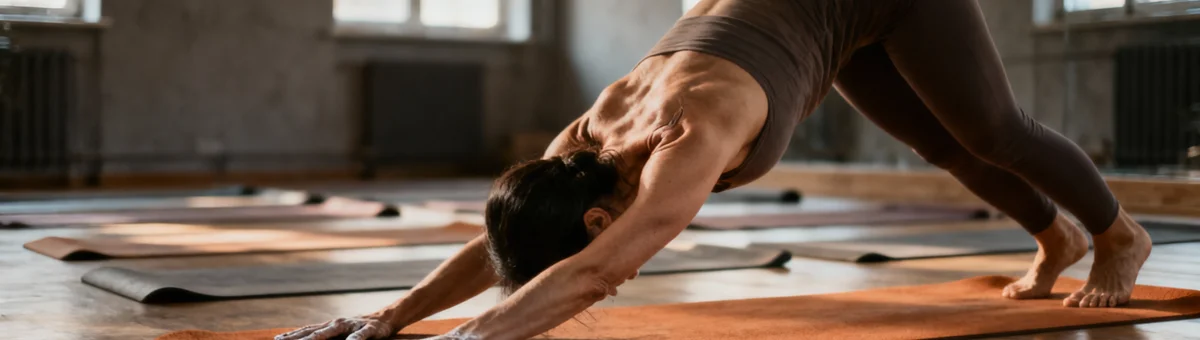
A woman in a class I taught once came out of Downward-Facing Dog with her jaw locked, her palms pale against the mat, and a look that said she was trying very hard to be a good student.
She didn’t need more encouragement. She needed permission. We folded a blanket under her knees, moved her hands to a chair, and finally skipped the pose altogether. Later, she said the worst part had not been the hamstring stretch. The worst part was the old familiar shame of not being able to do what everyone else seemed to do.
That is the piece many stress relief yoga articles skip. Yoga can reduce stress, yes. Yoga can also become another place where people compare, push, apologize, and quietly leave feeling worse. The pose is innocent enough. The meaning we attach to the pose can get heavy.
If yoga raises your stress, look closely at the conditions around the practice. Was the room too hot? Were the instructions too fast? Did a teacher adjust your body without enough consent? Did the pose create pain, dizziness, pressure in the head, numbness, or a sense of emotional flooding? Those details matter more than whether the pose appears in a “best poses for stress” list.
I have changed my mind about discomfort. I used to believe, with more certainty than I’m proud of, that staying with discomfort was almost always the doorway into growth. That belief came from real practice, but it was incomplete. Some discomfort is useful: the mild trembling of effort, the tender stretch that stays breathable, the awkwardness of doing less than your ego prefers. Other discomfort is a warning flare.
The difference is not always obvious.
For injuries, pain, and chronic conditions
If you have injuries or chronic conditions, stress relief yoga should be adapted before it is intensified. Fibromyalgia, hypertension, joint instability, back pain, migraine patterns, and post-viral fatigue can all change what “gentle” means in your body.
Gentle yoga for stress might mean practicing in bed. It might mean no inversions, no long holds, no breath retention, no hot room, and no teacher who insists that one alignment cue belongs to every spine. If you live with hypertension, ask your clinician about breath retention and inversions before practicing them. If fibromyalgia flares after exertion, consider shorter practices with rest built in before and after, not as a reward but as part of the practice itself.
The NCCIH guidance on yoga for health emphasizes speaking with a health care provider when you have medical conditions and choosing a qualified instructor. That advice can sound boring until you are the person whose shoulder aches for four days because a “relaxing” class included twenty planks.
Chair yoga is not lesser yoga. Wall-supported balance is not lesser yoga. Resting in Constructive Rest with knees bent and feet on the floor is not a failure to practice. The breath does not care whether your shape photographs well.
When stress relief yoga is adapted well, the nervous system receives a different message: I don’t have to earn care by enduring harm. That message can take months to believe.
When anxiety is severe
Yoga can sit beside therapy and medication; yoga does not have to compete with them. The NYU Langone report on the 2026 JAMA Psychiatry trial is useful here because Kundalini yoga helped many participants with generalized anxiety disorder, but cognitive behavioral therapy helped more. A mature yoga practice can hold that fact without defensiveness.
If anxiety keeps you from sleeping, eating, driving, working, or feeling safe in your own home, yoga may be a support rather than the center of care. I say that gently, but plainly. Breathing on a mat is not a moral substitute for getting help.
There’s a kind of spiritual bypassing that wears linen and speaks softly. It tells people to meditate instead of grieving, to stretch instead of naming harm, to breathe instead of asking for medication when medication is appropriate. I don’t trust that voice anymore. I’ve heard it in wellness rooms, and sometimes, uncomfortably, in my own mind.
Yoga is most healing when it tells the truth about its limits.
Stress Relief Yoga Begins in the Minutes Before Practice
The minutes before practice often decide whether yoga becomes a refuge or another task with a nicer vocabulary.
Before the mat is even unrolled, the nervous system is already reading the room. The phone on the floor. The rushed changing of clothes. The inner bargain: “If I do forty minutes, then I’m allowed to rest.” The body hears all of that.
I once found myself sorting a drawer of mismatched keys while the kettle hissed, telling myself I would practice as soon as the drawer made sense. There were tiny brass keys, a luggage lock key, a bent one with a blue plastic cap, and not one of them opened anything I still owned. My shoulders were up near my ears. The mat was six feet away. I was delaying rest by organizing useless metal.
That is not a grand spiritual anecdote. It is just the kind of thing a stressed mind does. The mind creates a small, controllable mess because the larger mess has no handle.
Stress relief yoga can begin right there, before the first pose, with a pause that respects the threshold. The threshold is the moment between doing and practicing. Cross it too quickly and you bring the whole day onto the mat in muddy shoes.
A pre-practice ritual does not need candles or special music. It may be as plain as:
- Put the phone in another room, face down, or on airplane mode.
- Stand still for three breaths before choosing a practice.
- Ask, “Does my body need movement, rest, or support?”
- Choose one pose you are allowed to skip before class begins.
- End the practice before you are depleted, not after.
The last one is harder than it sounds. Many of us stop only when the body has made refusal unmistakable. Stress relief yoga asks us to hear the whisper before the shout, which is irritatingly subtle work.
If transitions are the part of the day where your stress spikes — moving from work to home, caregiving to sleep, screen time to silence — you may find support in practicing mindful transitions during ordinary routines. Yoga does not have to stay fenced inside a class. The breath you take before opening the front door counts.
Tracking progress without turning your nervous system into a project
Long-term progress in stress reduction often looks less like constant calm and more like quicker recovery. You still get tense. You still have sharp days. You still forget everything you know and hold your breath while reading a two-line text.
Progress may mean you notice sooner. Progress may mean you apologize before bedtime instead of three days later. Progress may mean your neck tightens, but your whole afternoon doesn’t disappear into the tightening.
I like simple tracking because memory is moody. A stressed mind often says, “Nothing is helping,” even when the body is sleeping a little better or snapping less often. For one month, after practice, write down four plain notes: practice length, one pose or breath used, stress level before, stress level after. Use a scale of 1 to 5 if numbers don’t make you obsessive.
At the end of four weeks, look for patterns instead of perfection. Does five minutes help more than zero? Does evening practice disturb your sleep while afternoon practice settles you? Do hip openers bring up emotion that needs gentler pacing? Does breath counting soothe you, or does it make the mind stricter?
Tracking should feel like placing pebbles on a windowsill, not building a courtroom case against yourself.
If mindfulness itself feels foggy or overcomplicated, a steady mindfulness meditation guide can help you separate present-moment awareness from the pressure to feel peaceful. Peace is sometimes a guest. Awareness is the door you can open.

Is Yoga Better Than Meditation for Stress?
Yoga is not better than meditation for stress; yoga and meditation answer different needs in the same human body.
Some days, seated meditation is the cleanest medicine. The body is tired, the mind is busy, and sitting with the breath reveals the pattern without adding more movement. Other days, meditation feels like being locked in a small room with a committee of anxious voices. On those days, gentle yoga for stress may be kinder because movement gives attention a place to land.
Yoga also contains meditation when practiced with awareness. A slow transition from standing to kneeling can become meditation. Feeling the palms press into the floor can become meditation. Resting in Savasana while noticing the impulse to get up and be useful can become a very direct meditation on your relationship with rest. A little uncomfortable, perhaps. Good.
Which yoga pose is best for work-related stress? In my experience, the “best” pose is usually the one you will actually do without changing clothes, clearing a room, or needing twenty uninterrupted minutes. Legs on a chair is a quiet favorite. So is a standing forward fold with bent knees and forearms resting on a desk. So is turning away from the screen, placing both feet on the floor, and lengthening the exhale while your hands rest on your thighs.
Work stress often has a compressed quality. The chest narrows. The eyes harden. The breath becomes shallow because the body is acting as though the deadline is a predator. A desk-friendly stress relief yoga pause should widen the body’s sense of space without asking for drama.
Try this at work, if your body allows it: sit near the edge of your chair, feet flat, and place your right hand on the outer left thigh. Inhale to lengthen the spine. Exhale into a small twist. Keep the jaw soft. After three breaths, change sides. Then look at something farther away than your screen. The eyes need distance too.
How soon do you feel stress relief from yoga? Sometimes in one exhale. Sometimes after several weeks of showing up with less self-criticism. The immediate effect may be a warmer face, a lower pulse, or a sense that the room has stopped leaning toward you. The longer effect is quieter: you begin to trust that stress can move through you without becoming your only weather.
The Hidden Stress of Being Inconsistent
Inconsistent practice can create its own strain when yoga becomes another measure of whether you are disciplined enough, spiritual enough, or calm enough.
I want to say this softly: missing practice is not a character flaw. It may be a sign that the practice is too long, too rigid, too physically demanding, too boring, or too tied to an ideal version of yourself who apparently has endless clean laundry and no nervous system.
There are seasons when I practice daily. There are seasons when I practice in crumbs. One hip stretch while the bathtub fills. Three breaths before a difficult phone call. A supported rest pose after lunch because sleep was thin the night before. Crumbs still feed the body.
The emotional cost of inconsistency is often self-blame. A person feels stressed, remembers yoga helps, then feels guilty for not doing yoga, which adds more stress. The loop is almost comically unfair. And yet many sensitive, sincere people live inside it.
Stress relief yoga needs a lower doorway.
Instead of asking, “Did I practice today?” try asking, “Did I give my body one moment of non-aggression?” Non-aggression might be uncrossing your legs when your knee aches. It might be turning off a video that moves too fast. It might be lying on the floor with calves on the couch while the dog sniffs your hair and the dishwasher clicks through its cycle.
A short practice done with kindness usually teaches the nervous system more than a long practice done as punishment. I’m fairly certain about this, though certainty always softens when I sit with real people and their complicated lives. A parent with two jobs, a person in active grief, someone with chronic pain, someone caring for an aging partner — “just practice every morning” can become cruel advice when it ignores the shape of a life.
So build a practice that can survive being interrupted. If you can only practice when conditions are perfect, the practice belongs to the conditions, not to you.
A Gentle Way to Begin Again
A sustainable stress relief yoga practice begins with consent, adapts to the body in front of you, and measures progress by recovery rather than perfection.
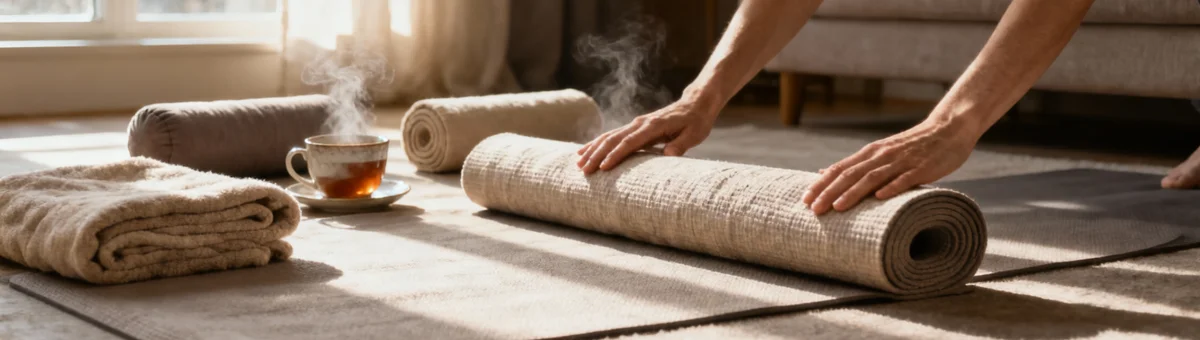
If you are beginning again today, begin smaller than your ambition. Put one blanket on the floor. Sit on it. Feel your hands. Let the eyes lower or stay open. Notice whether the breath wants to be guided or simply witnessed.
Then choose one shape that does not argue with your body. Maybe Constructive Rest. Maybe legs on a chair. Maybe Cat-Cow at the kitchen counter. Stay for five breaths. Leave before the mind starts making speeches about what this should mean.
If you want a complete tiny practice, use this:
- Arrive: Stand or sit still for three natural breaths, eyes open if that feels safer.
- Mobilize: Move the spine gently through Cat-Cow or seated rounding and arching for six breaths.
- Release: Rest in a supported forward fold, using pillows or a chair, for five slow exhales.
- Settle: Lie down with calves on a chair for two minutes, letting the floor hold your back.
Nothing in that practice needs to look impressive. The nervous system is not impressed by aesthetics. The nervous system listens for repetition, safety, and whether you stop when something feels wrong.
Can yoga for stress relief help with chronic anxiety? Yoga may help some people with chronic anxiety, especially as part of a wider care plan that includes therapy, medical support when needed, sleep care, and honest conversation. The NYU Langone report gives a hopeful but grounded picture: yoga helped many participants, while cognitive behavioral therapy showed stronger results in that study.
What if you can’t do certain yoga poses due to injuries? Skip them. Modify them. Replace them with breath, rest, or a smaller movement that keeps your body out of threat. A pose you cannot do is not a locked door; it is information.
The deeper invitation is to stop treating yoga as a way to become someone else. Stress relief yoga, when it is wise, returns you to the person already breathing under the noise. The person with tight shoulders, good intentions, uneven practice, and a body that has been trying to protect you all along.
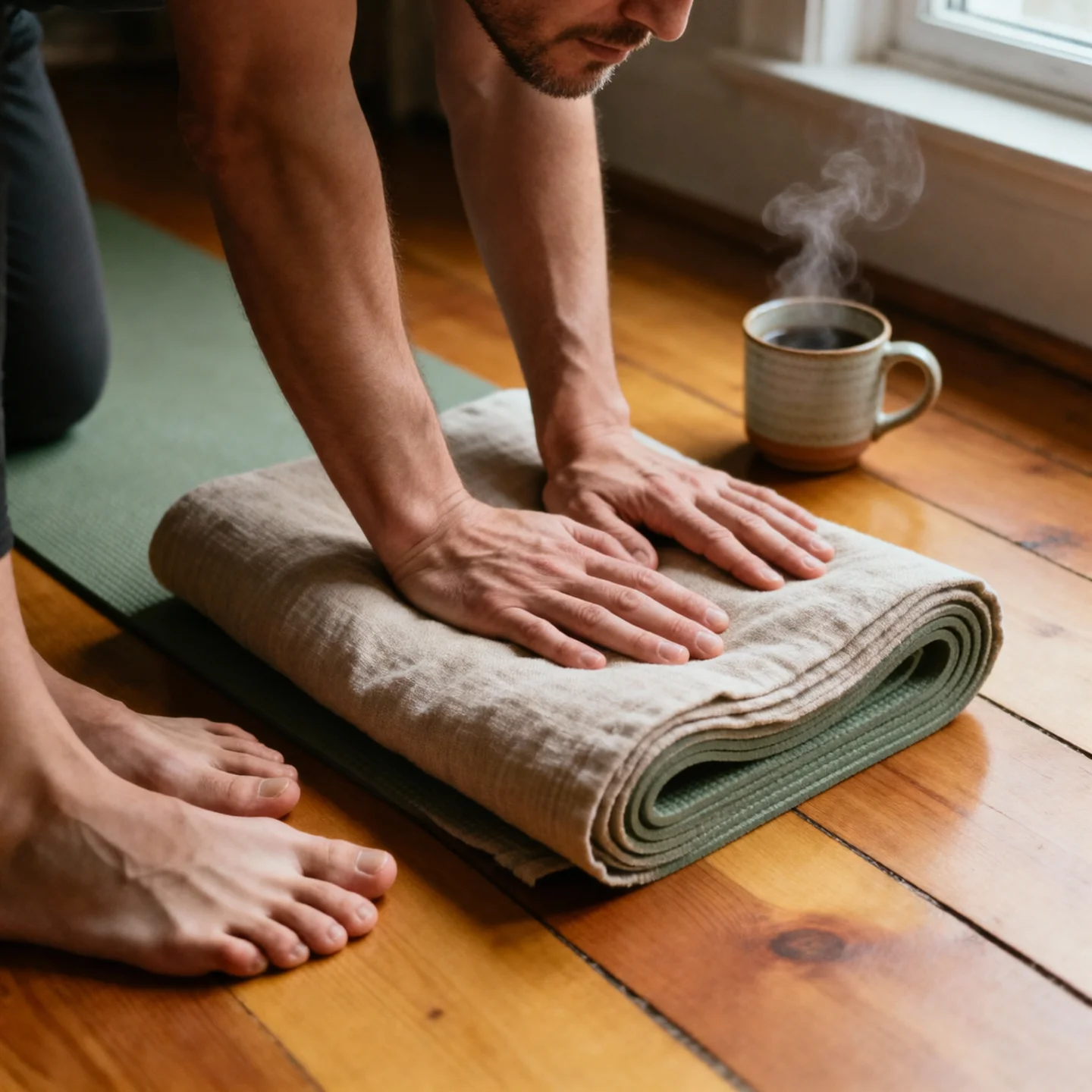
After the practice, let there be a plain ending. Fold the blanket. Move the chair back. Notice the little crescent marks the mat leaves on your palms, fading while the room stays quiet.
Frequently Asked Questions
How does stress relief yoga start before you unroll the mat?
Stress relief yoga can start with a simple pause before movement, such as taking one slow breath or relaxing your jaw. This helps signal safety to the nervous system before you begin any poses.
What is the best yoga for stress relief?
The best yoga for stress relief is usually gentle, slow, and breath-focused, such as restorative yoga, yin yoga, or simple mindful stretching. The goal is not performance but helping the body feel calmer and more supported.
Can one breath really help reduce stress?
Yes, one intentional breath can help reduce stress by creating a brief pause between tension and reaction. Over time, these small pauses can make it easier to approach your body and day with more kindness.
How often should I practice stress relief yoga?
You can practice stress relief yoga daily, even for just a few minutes. A short, gentle routine done consistently is often more helpful than a long session done only occasionally.